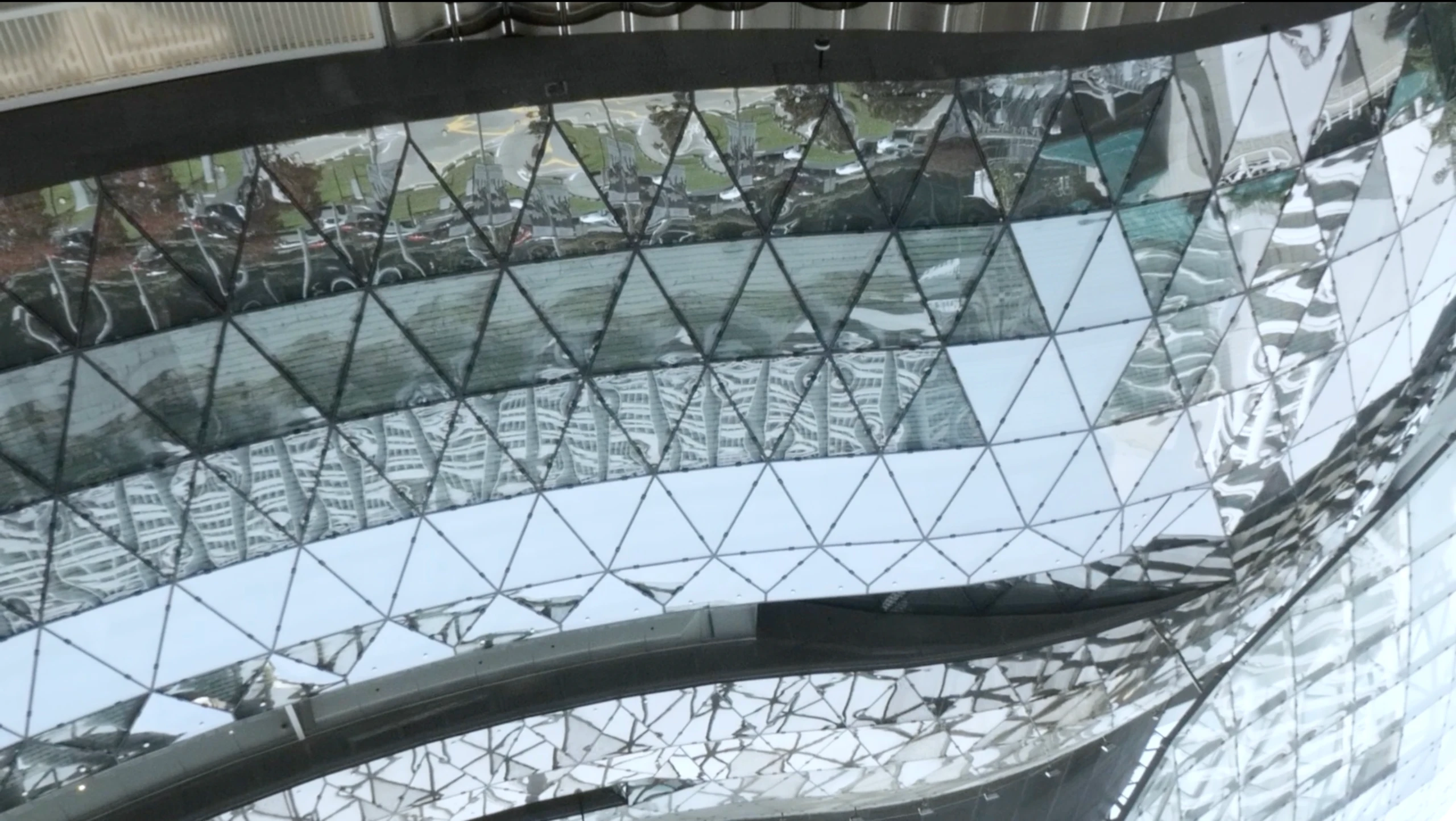
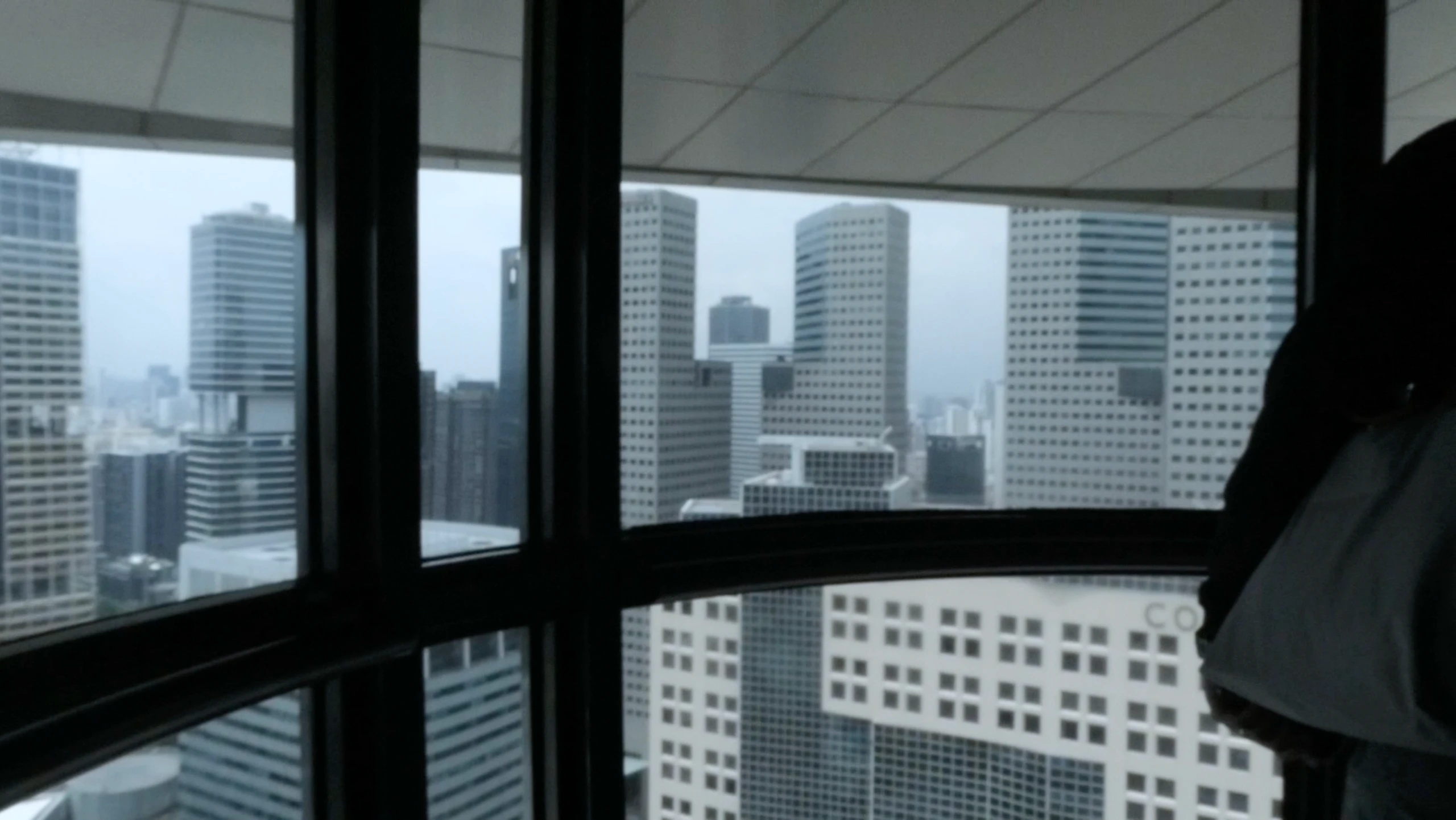
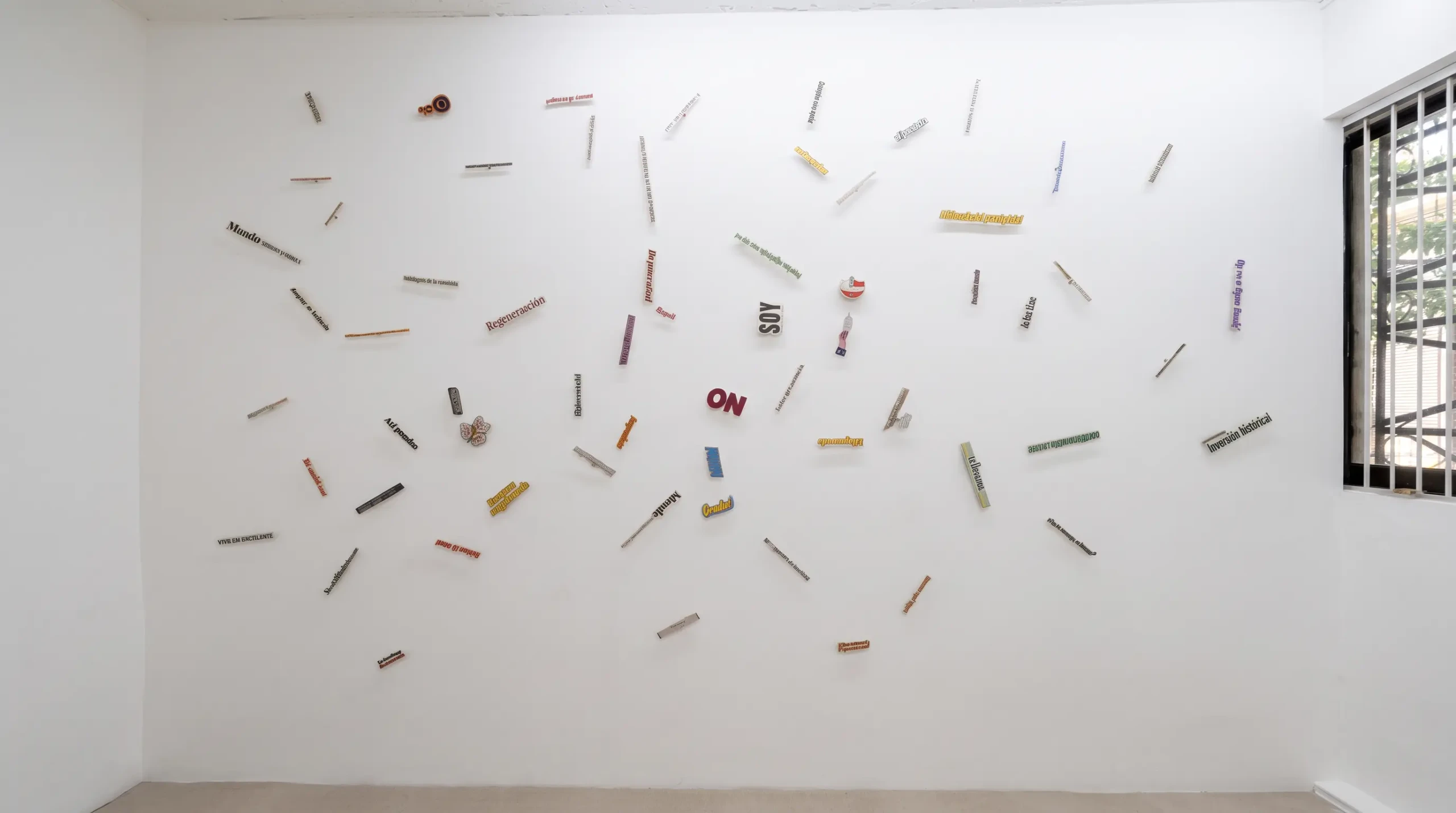
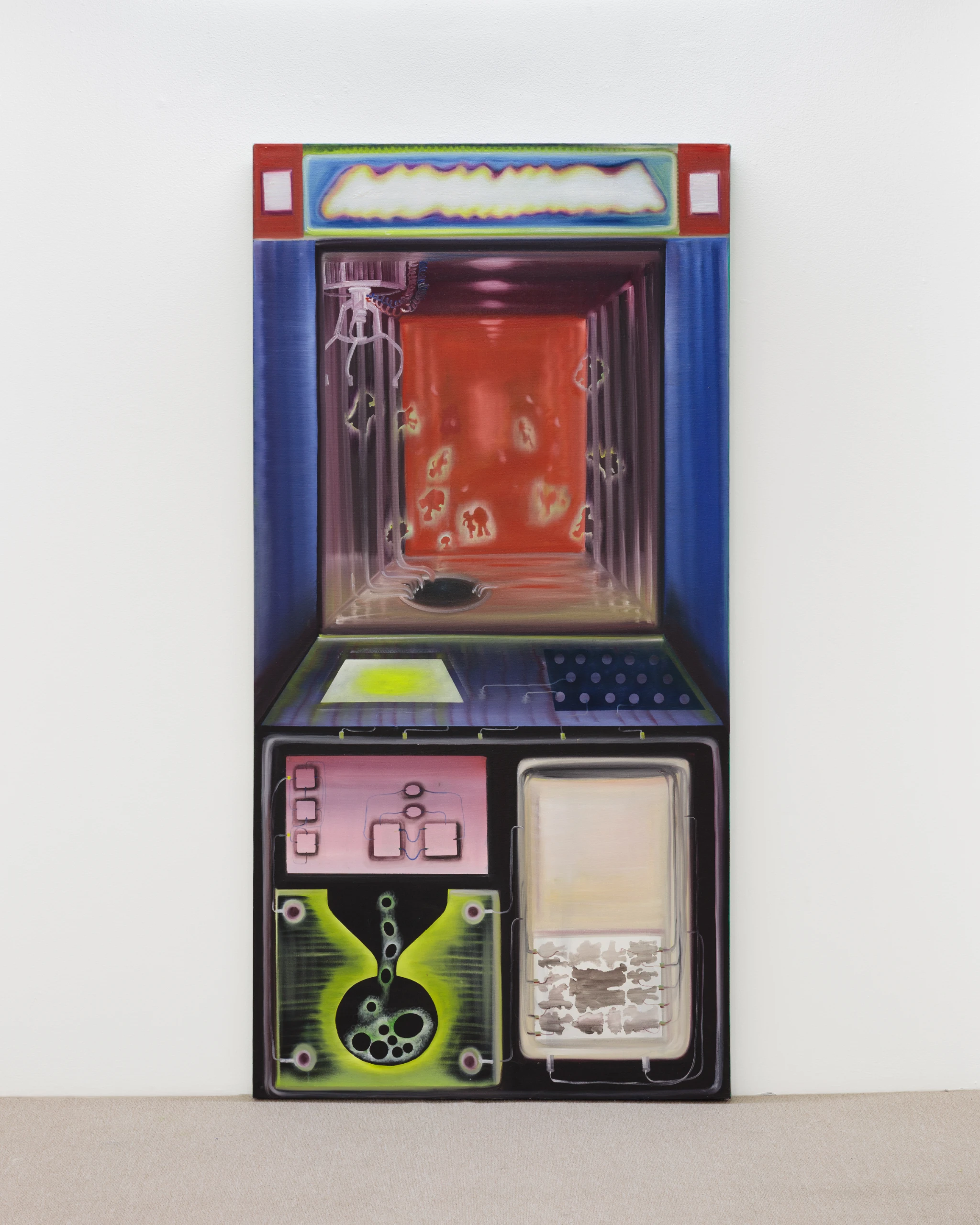
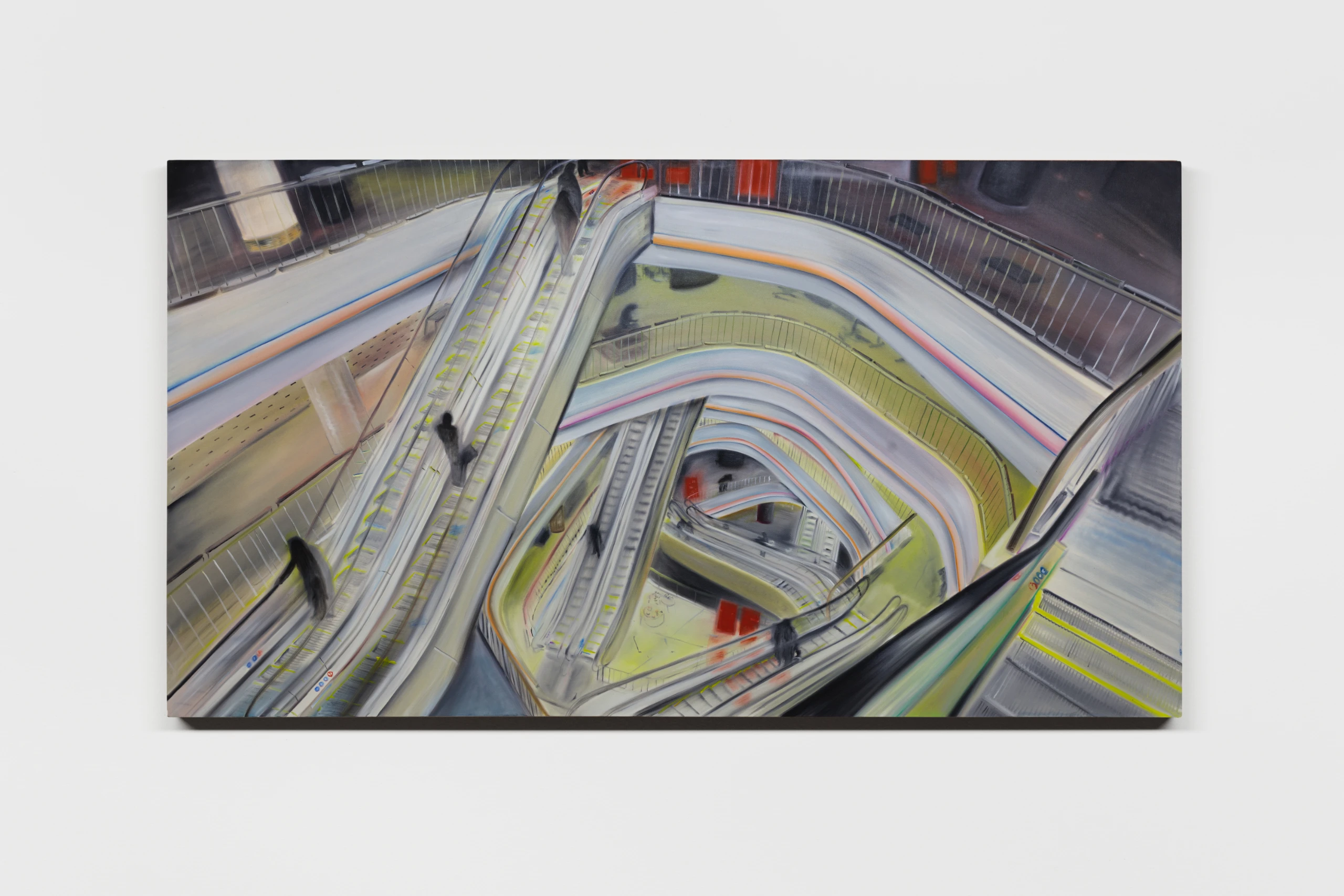
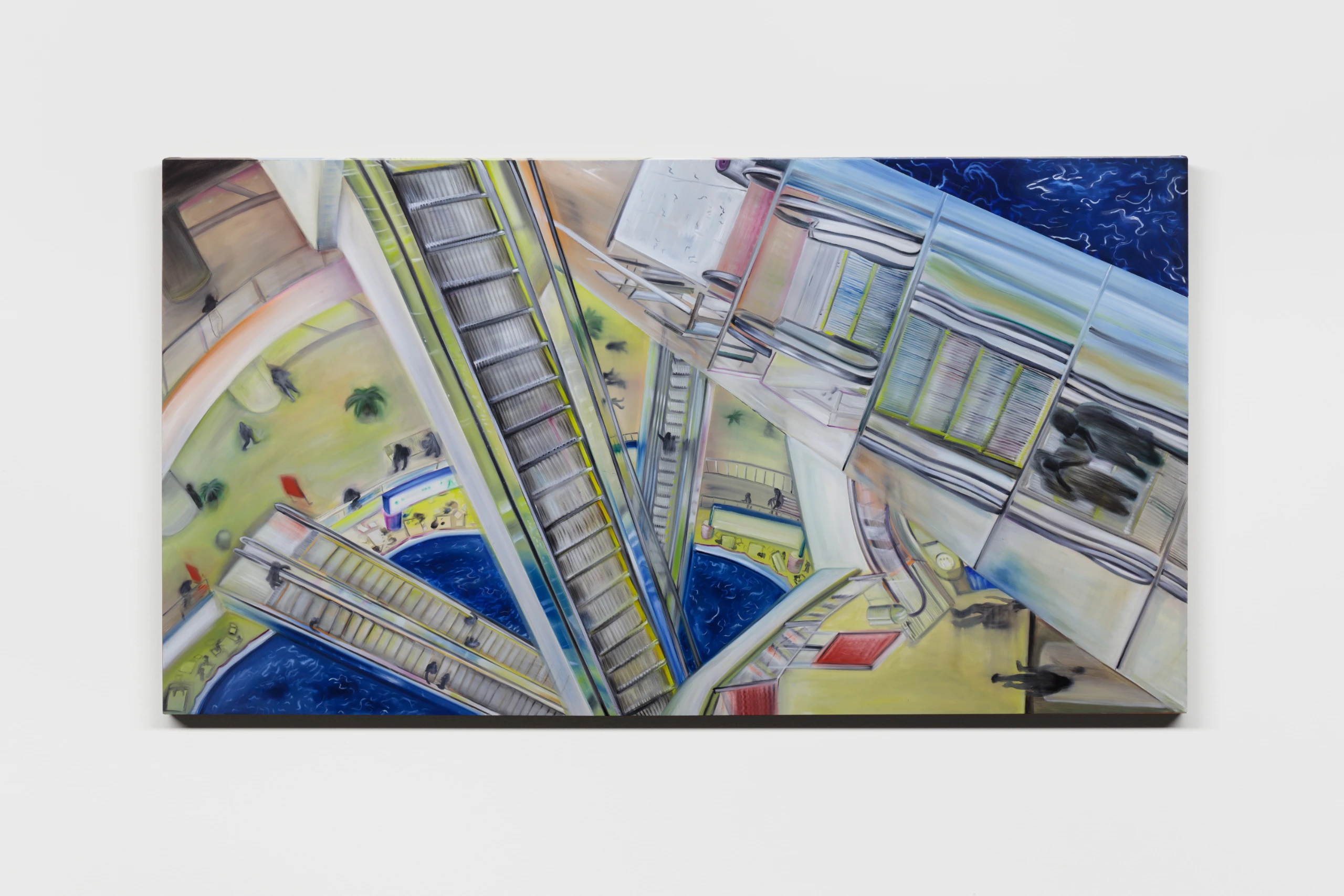
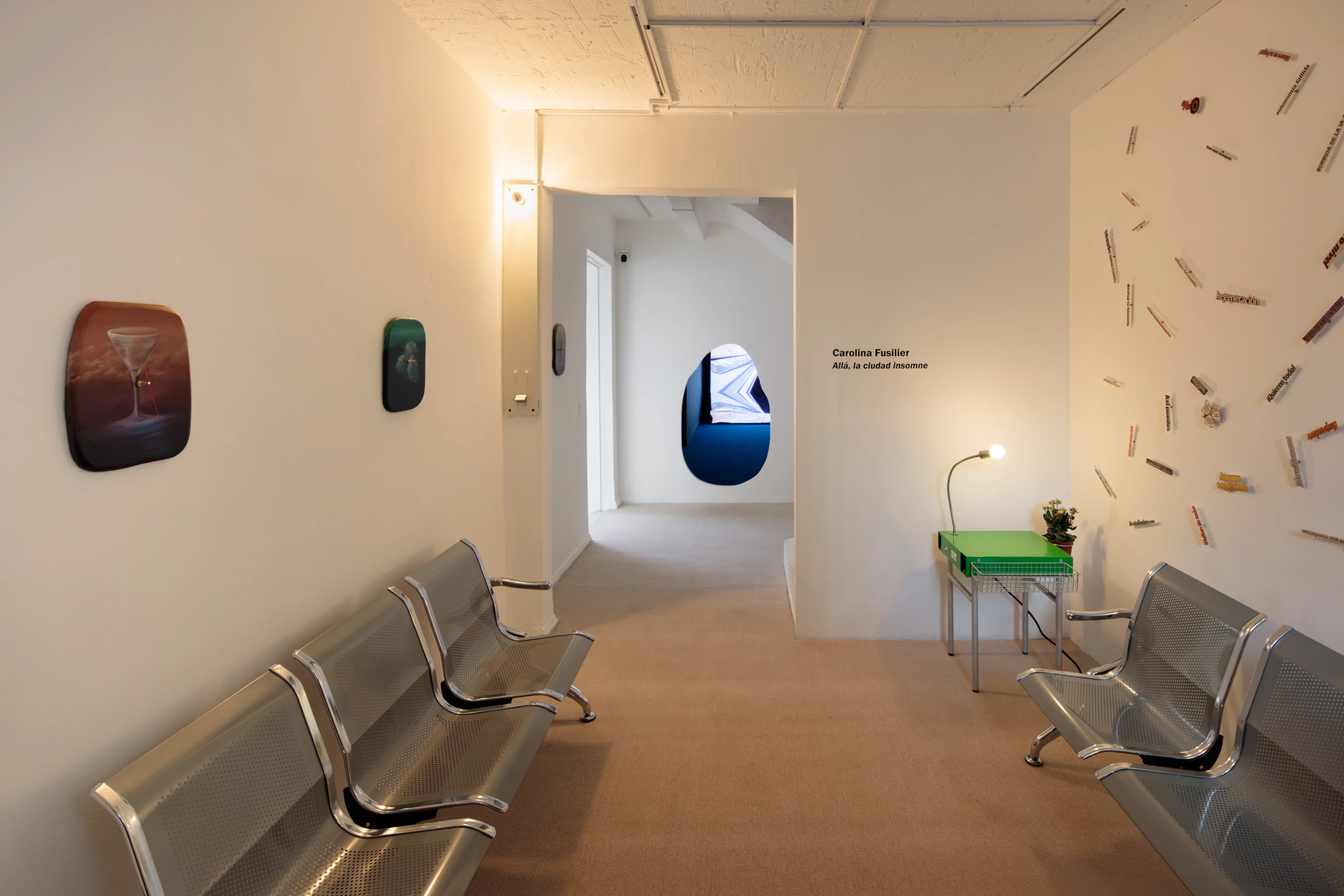
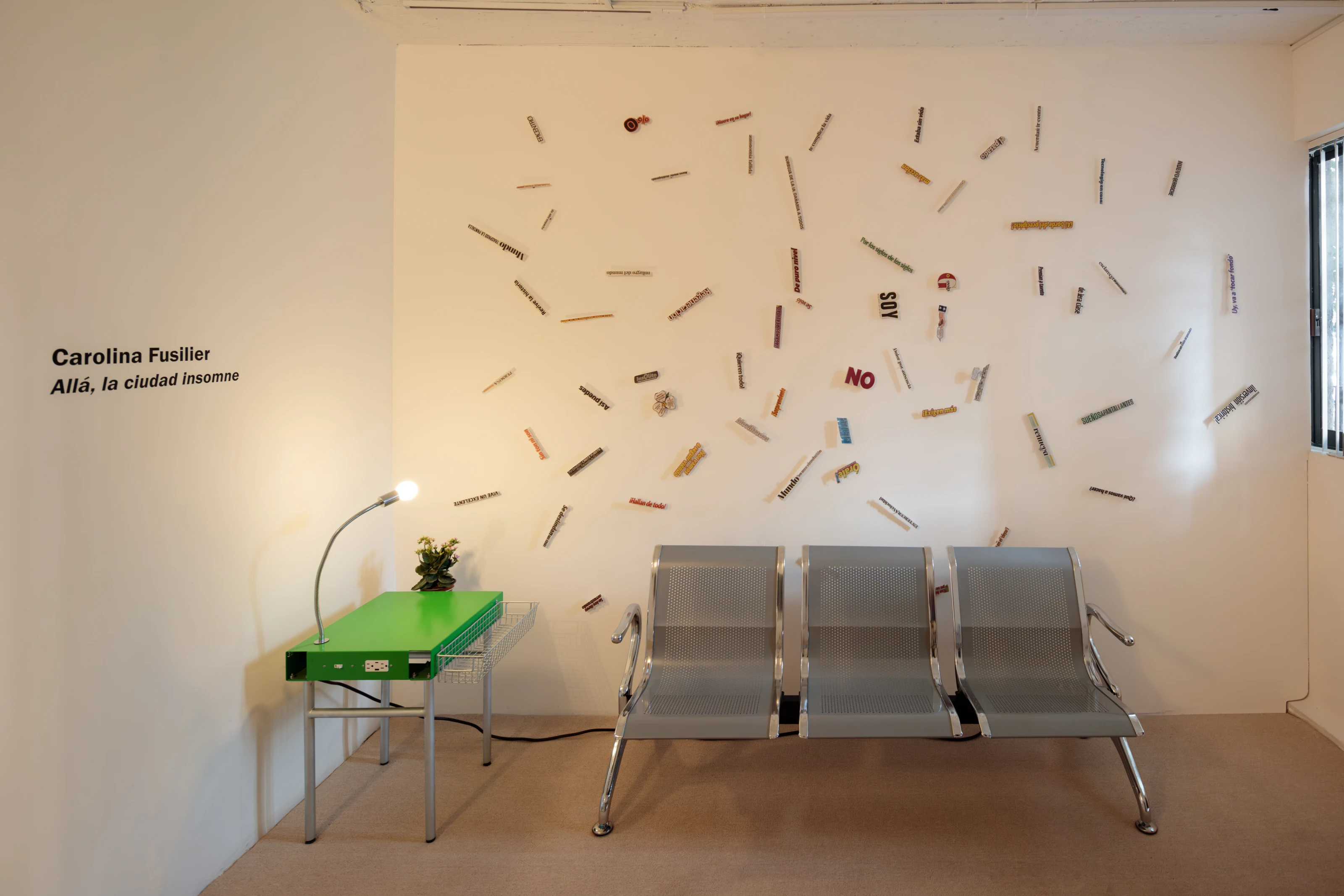
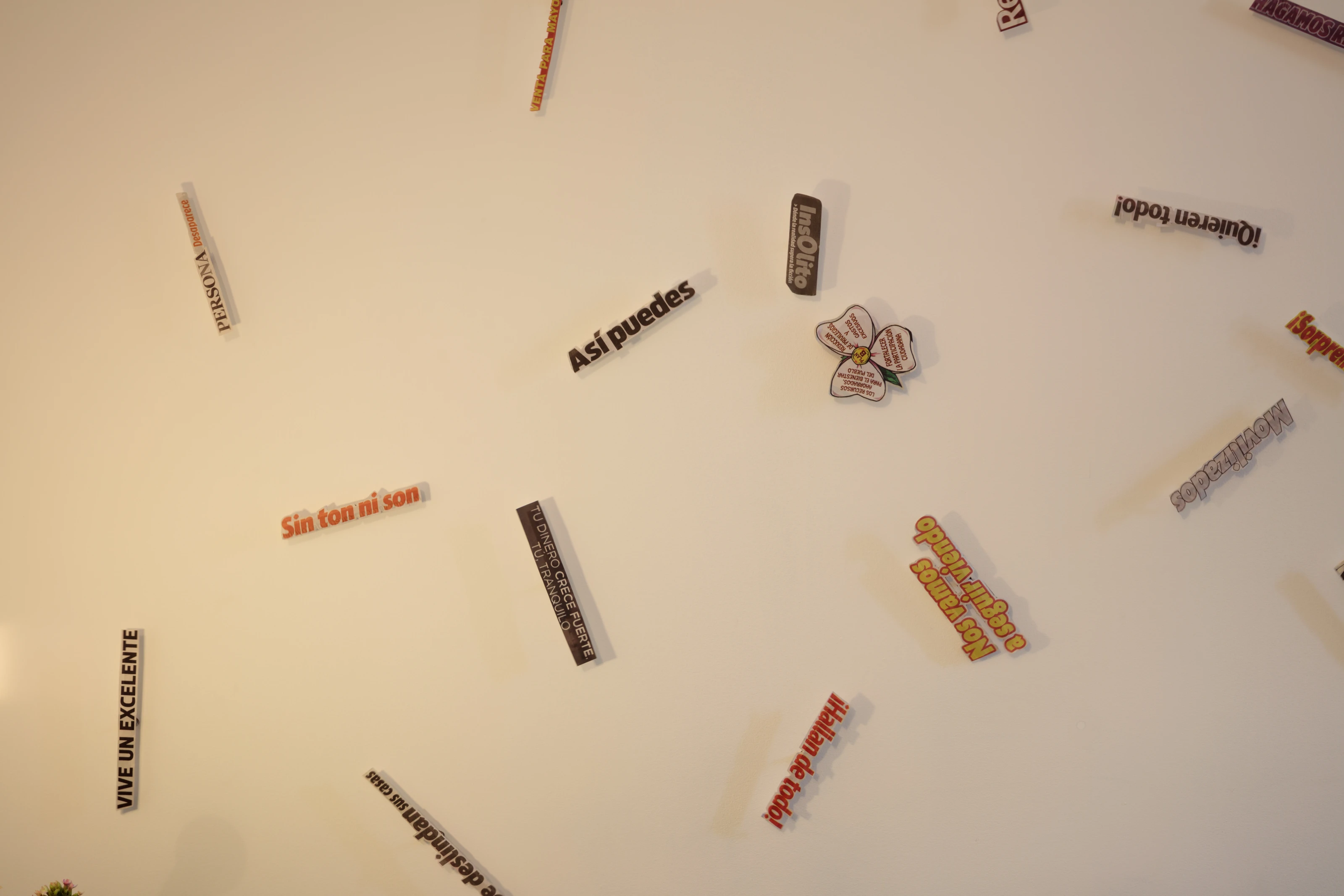
"Through a video installation—which shares its title with the exhibition—and a series of spatial interventions, Allá, la ciudad insomne explores the physical and emotional relationship between the body and architecture. These works reimagine and unpack a memory from my childhood in 1990s Argentina: getting lost in a shopping mall. This foundational scene is intertwined with a moment of both generational and personal transformation—my pre-adolescence coincided with the most brutal phase of the neoliberal project.
Between 1990 and 2001, more than 30 shopping malls were built in Buenos Aires and its surrounding areas. These structures served as formative spaces for my generation; the indeterminate stretch of time I spent lost within one encapsulates a new, phenomenological relationship with space-time. Architecture dictates a sense of orientation—a physical, emotional, and psychological connection to the world. Looking back, I can examine how these visions of progress prepared us for a future in which our sensibilities continue to be shaped, albeit in different forms.
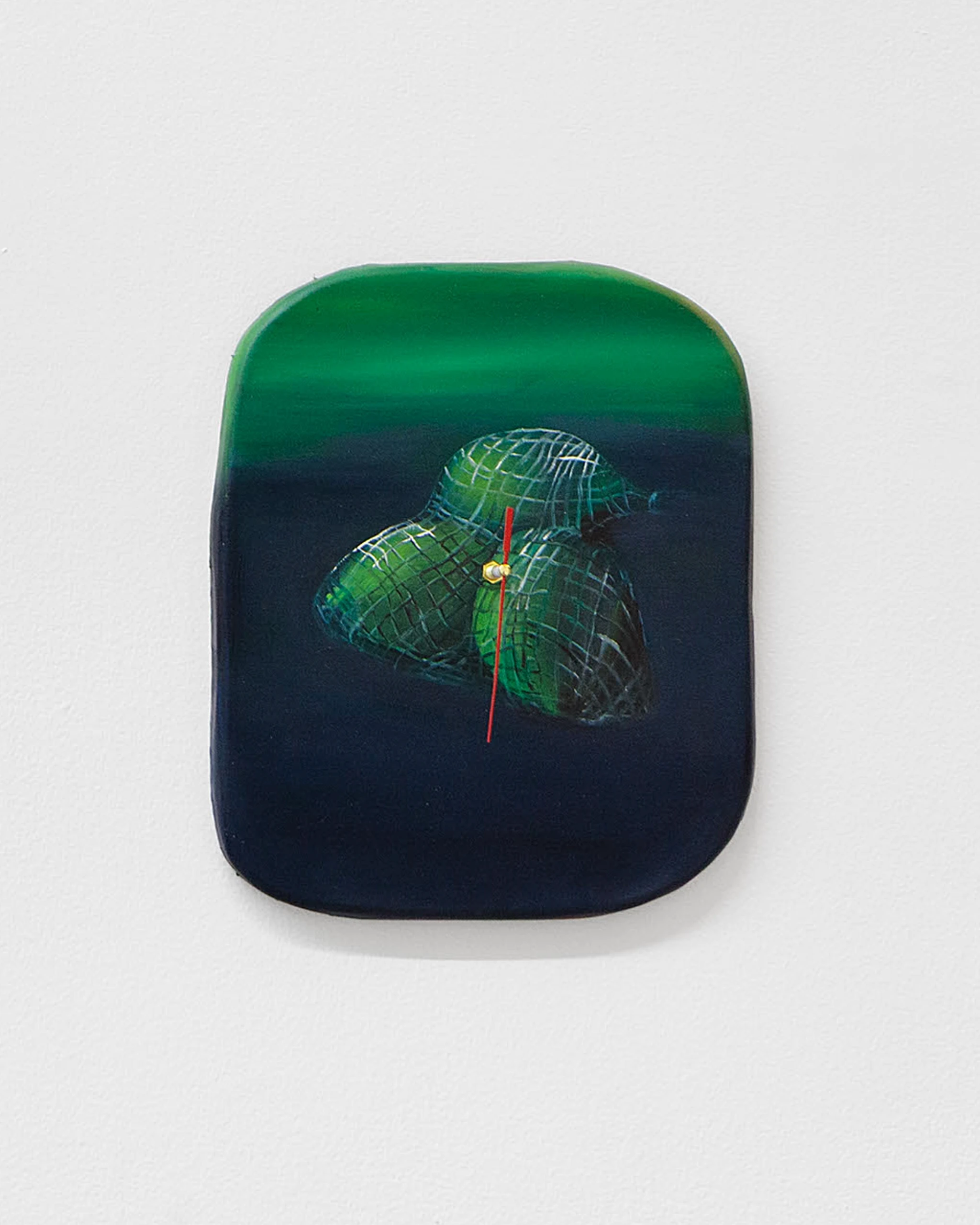
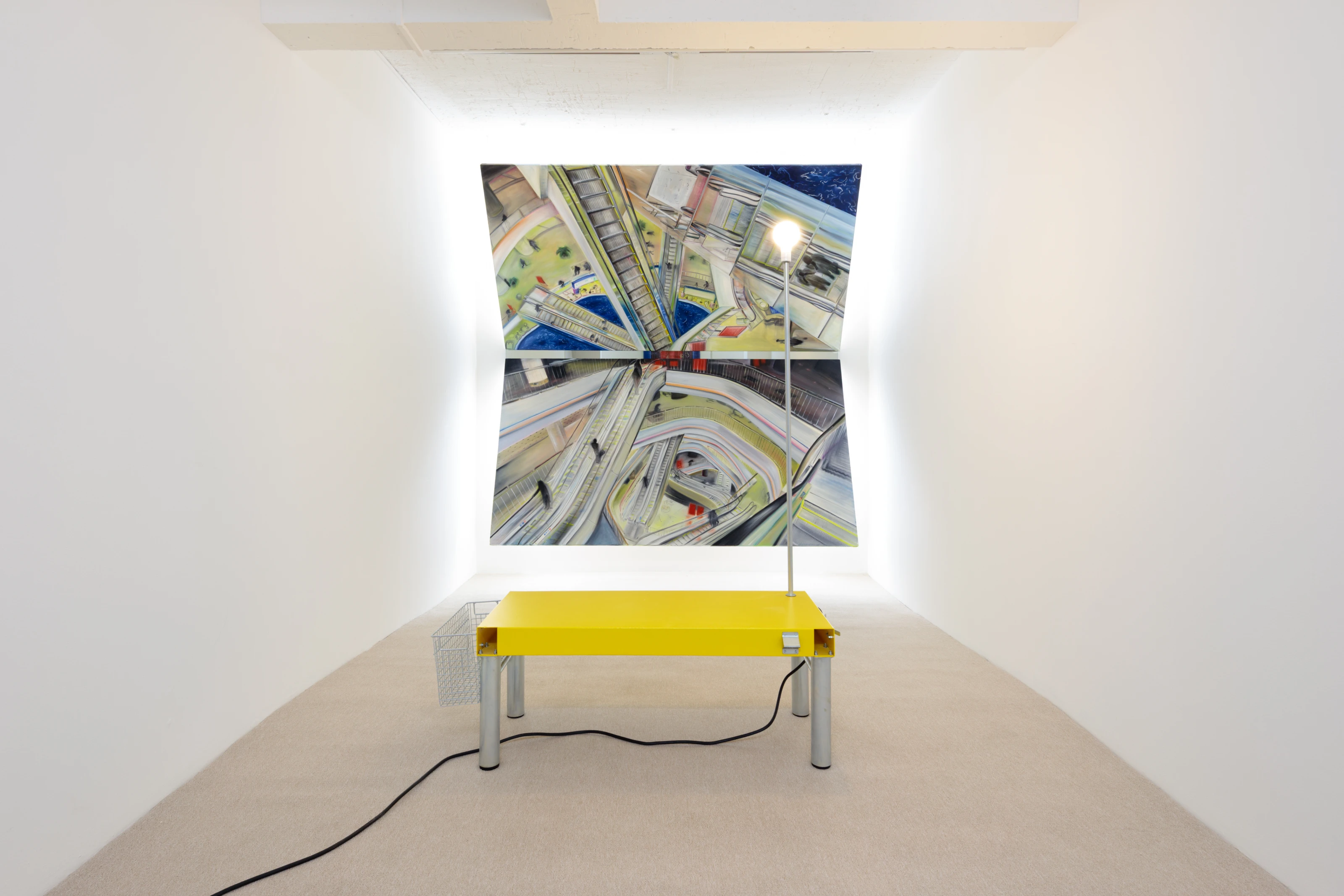
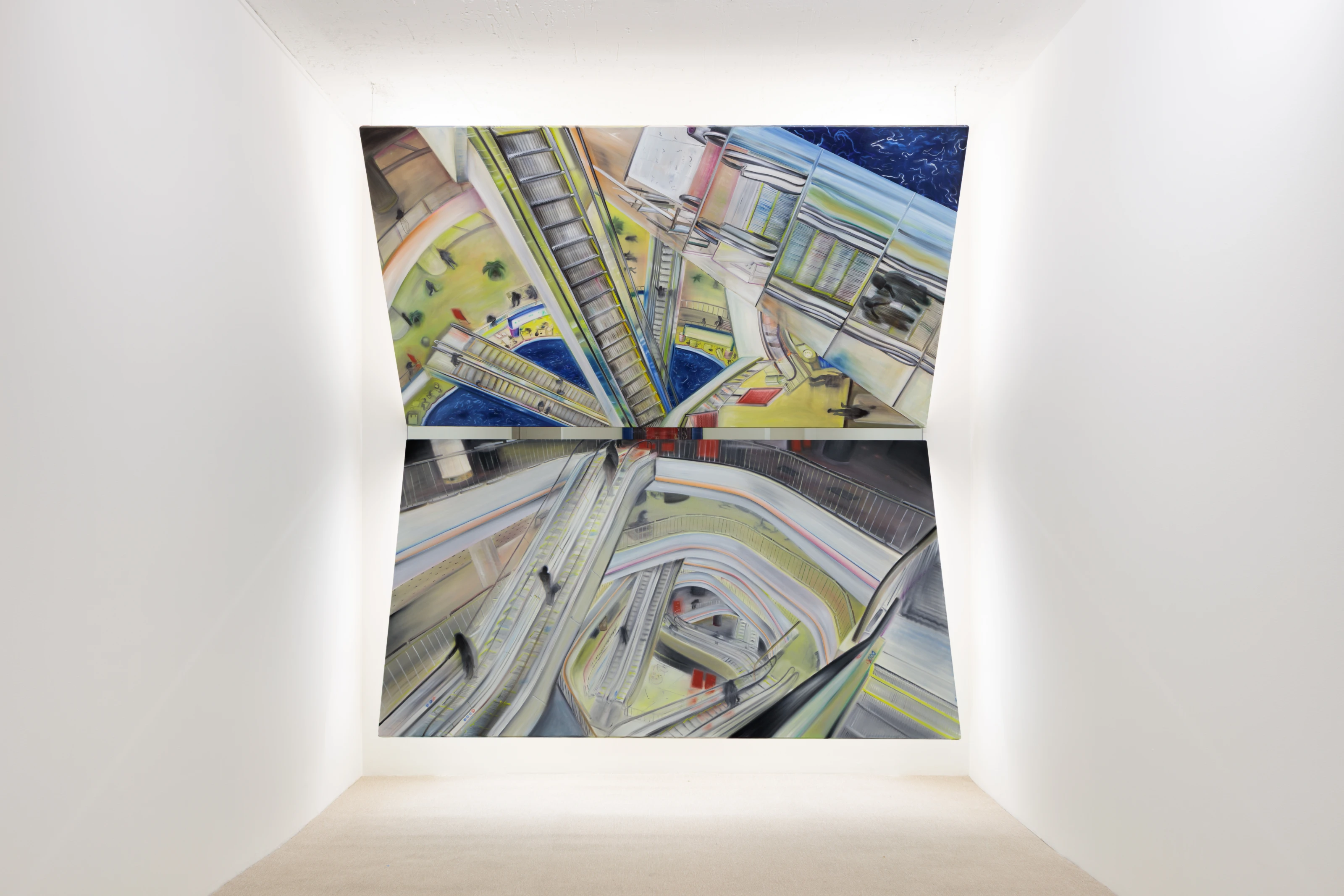
The collision between the soundscape of a rural setting (where I currently live) and the traversal of these alienating, self-reflecting megalopolises creates an unstable, geographic kaleidoscope: the boundaries between "outside" and "inside" are continuously drawn and interwoven. Here, the paintings take on a scenographic presence that responds to the gesture of the video, becoming mirror-paintings that unfold the infinite space of the sleepless city.
The exhibition includes an essay by José Segebre on the architecture of waiting, along with several "Spatial Accessories" designed by APRDELESP for the reception area—now transformed into a waiting room. Within this threshold of waiting—conceived as an introductory space for encounter and reading—I propose a collectivization of what it feels like to exist in our current moment: a reality difficult to translate, defined by its anachronism and its cyclical, regressive state."
Waiting in Hallways
They died in Berlin, October 2023, and left an abrupt and brief legacy. It is anonymized and edited for this exhibition: Allá, la ciudad insomne.
The archive consists of three folders. I immersed myself in the texts which, like our conversations, meandered around waiting, that phenomenon as detested as it is normal.
The waiting that interested them was often, like their prose, without a clear beginning and to obscure ends. Oscillating between state and self-censorship, their legacy is reduced to journal entries. A colloquial tone points back to their disenchantment with everything that once seemed to have sheltered them.
Posthumously as much as in life, we could speak of paranoia, a compulsion toward the other who is always there to subjugate: life is fucked, a relentless rip-off, and that someone, alone over there, came to fuck you over.
And yet, even at their most paranoid, a fervor always revealed itself in their art and ideas, one now understood as love of the world. The world’s vastness inspired them even as it overwhelmed them.
In an unexpected reunion that I recount in more detail in this prologue, they described their relationship to waiting and to the world in this way: “When the host opens the door and one walks in, accepting shelter, only to realize that both became hostages of themselves.”
These fragments bear witness to a life that was rarely whole. None of the entries were dated beyond the year 2023, written on the manila folder containing them. Nor did they leave any concrete wish regarding their future. Thanks to Carolina Fusilier, who generously provides the context and occasion for this diary of waiting, we share with you an unpublished legacy.
Our last conversation revolved around a painting that mirrors these prologued observations which, like waiting in hallways, drag out, fold and unfold again.
We saw the painting in a New York exhibition space. It was our first time in the city. We hadn’t seen each other in two or three years, though we had kept in touch and even crossed paths. The years had snuck up on us. The reunion was rather unexpected. A series of coincidences marks the way toward desire.
We got lost in the Dream House, a room tinted in purple light and filled with an incessant drone. I think we were lost, rather, in our conversation. Together at last without any fear of the future or of precarity, not hungry and full of energy, wandering through Chinatown. I don’t know if it was attraction or repulsion that pulled us off the sidewalk into this gallery space, but an enlarged detail of the painting was printed on a poster hanging in the window.
We recognized him immediately, a very expensive nerd of the so-called Chicago School. The most gringo thing in the world and at the same time a stylistic hedonism that captivated us.
We’ll never know if it was coincidence or destiny, but the painting shows a group of unemployed people seated on chairs, their backs to us, with their hats from another time, shoulders sunken, and hallways between desks that multiply one after another and likewise trace lines toward the ceiling, infinitely prolonged. The waiting is reflected on the ceiling and on the walls. It is the interior of a government office.
It resembles Kafka’s “Before the Law” (1915), a matryoshka of waiting: behind this door there is another door with another guard, and so on. One bureaucratic situation leads to another, and so the waiting multiplies, and the places where we wait for our turn to lead us to a hallway that leads us to another room with another door with more hallways, and so the promise of waiting…
Everything in the painting is the same color; the grid of chain-link fence caps off the kaleidoscope of architectural structures, literalizing at the level of matter the labyrinth of mirrors that waiting is in this painting, or rather: the labyrinth of mirrors as liminal spaces that painting itself is.
A room that leads to another room, that promises movement, but in fact nothing moves, it is only an illusion, a sea of stairs floating over another sea of stairs: the promise of empty movement.
Memory, or at least this particular one, seems to share something with that whirlpool of a void, which, round and around, evokes closeness without granting it. Perhaps that is what is so complacent about memory, that repetition which refers back and promises to settle things without interrupting the impossibility of touch, that insurmountable distance between a finger and the skin, the now and the then.
I remember entering the space and that we turned to look at each other, excited and somewhat self-exiled in this coincidence of a painting within the coincidence of reunion. A whirlpool that is revisited and re-edited to highlight the passive pleasure of waiting and of all existence—always in-between, truncated like a segment of a spiral.
We were seeing an exhibition of our shared secret, the pleasure of consuming the posthumous artist few know about, the pleasure of being in the presence of the body of work without a corpse. Gravediggers are indeed the founding members of the art world.
And we found one painting. The rest were remnants of a sci-fi film production that were now the work of two contemporary artists. Publicity stunts and the hope that creation and the desire for recognition might be two sides of the same coin. A corpse in the middle, the lack of content self-historicizes.
I don’t remember the order of events that followed or every detail of our conversation, but we discussed something about the need for a more radical narcissism, one that sees itself in every surface without losing itself in the gaze of the other and instead uses that gaze, redoubled in the other, to look for points of collaboration, to generate echoes without an owner, and so to insist on waiting for the unexpected.
Now that I retell this encounter, it seems to me this is what Diedrich Diederichsen has at times called the posing of radical narcissism, a kind of posturing that deceives and at the same time appropriates gestures and grimaces to settle pending matters. A self-obsession that seeks waiting in hallways more so than a destination.
My intention is not only to share anecdotes. My intention is also to share a legacy that is not mine and that the person who made it did not share publicly in their lifetime, but which is at the same time our absolution. And that is why I share these leftovers with you, hoping that over there, Allá, la ciudad insomne offers you a sleepless interlude while waiting.
– José Segebre
I was reading in the doctor’s waiting room. I don’t know how it didn’t occur to me before, a diary of waiting…
They changed my doctor; now I have a German one, and I can’t stand him. The other one was German too, but at least he had worked in and around Mexico City, years that marked him, at least in his accent. I don’t know if there’s a way to heal with this new one.
This waiting room was more of a hallway: fold-down seats mounted on the wall, you get up, they fold back up. Some so old that you sit down and sink in. I suppose I’m not the first person waiting here, so I read and wait my turn. I just ran into someone from work, and well, smile and ignore them…
I’m not the first person waiting for a blood draw today. But I am the last. They forgot my name. The new doctor got lost in his explanations, paradigm shifts, mistakes that will never be repeated, empirical readings that prove to me they don’t have the faintest fucking clue what they’re doing in this office of tenured bureaucrats.
The hallway of waiting is somewhat modular.
I’ve been waiting for an hour and change. I finished two chapters of a book that left me more hopeless than the news. And that’s why the idea of hallways appeals to me. There’s at least something more honest about it: that they sit you in a line, the wall almost touching your forehead, having to cross and uncross your legs every time a reputable doctor goes for his little coffee at the end of the hallway.
I like this double liminality, waiting as an in-between doubled within the in-between of the hallway. There is no flow, only the brushing of passersby: narrow, compact, efficient. The hallway is the infinity of the in-between and at the same time a minor way for a long and brief stitch to double back and lay the groundwork for another beginning.
Behind this door you’ll find another, and so on. It seems to me that among those possibilities there is always a hallway to double down on. I suppose they spent all their efficiency on the architecture of waiting. There wasn’t enough left for the people.
What if I start recording everything I feel while I wait? And what if I’m waiting for the subway? Isn’t this the most mundane thing, waiting for a train car to stop as close to you as possible and open its doors?
Waiting for a train car leads to waiting until your destination inside a moving hallway. Heidegger left this as a complaint: that waiting for the train is first-order boredom. Time stands still as displeasure until the awaited thing arrives. The metro will arrive on time; until then, boredom. The second order of boredom seems deeper to him. He reserves it for coming home after a dinner with friends and realizing he was bored all night. Boredom stretches time, and we only notice after the fact. The third order, being bored of boredom, is perhaps more feasible and at the same time senseless. It’s being fed up with being fed up.
The truth is that waiting for the subway doesn’t bore me even though I do it every day. Dinner with friends doesn’t bore me either, and if it does, well, better leave, or cancel and get bored alone. On the contrary, right now as I wait for the subway I can’t stop looking at that boy’s frosted tips. Boredom is disconnecting from pleasure and being unable to await the unexpected.
I imagine myself flying in the not-so-distant future, seated on something like the flight attendants’ seats that unfold in unexpected places. I feel that life will unfold like this: a neoliberalization of architecture and design, where our presence as bodies who work, who wait, who care and seek care, is simply inconvenient.
There really is something strange about waiting, at least for someone who, like me, says or believes they have a precise and constant relationship with their senses, especially sight. (Though this could be due to my professional deformation and love for the world of ideas, the arts, cinema, feet, etc.)
In a moment of waiting the eyes get lost: melancholy reflections, routine chores, that profoundly existential boredom that says more about our lack of inner resources and leaves the excess of outer resources unquestioned.
Waiting is concentrated in rooms, and their doors act as mirrors, the square within the square. They fold and multiply, and one room leads to the next; waiting produces more waiting. The architecture of waiting is concentrated in halls and rooms, a spatiotemporal organization often without end, but which always has a beginning, even if it isn’t always clear.
I feel my eyes adjust and tighten, like after Vietnamese coffee. Maybe that’s why train and bus stations, and all these liminal spaces, like an airport, the escalators of a mall, or a parking lot (where cars wait by the hour), have so many ads.
I’m reading one that says “Euphoria at checkout”: a young woman, supposedly old in a gray wig, holds her phone, trapped in the commodity form of a thirtysomething body. The euphoria is because she can now pay faster.
“Youth is porn,” my boyfriend tells me.
I was just thinking about the difference between a waiting room and what ends up being a line, or even a border: aren’t they also architecture?
The waiting room contains; it’s not quite clear what, but it combs uncertainty, it paralyzes and offers shelter. The line is much more contested, or at least more monitored. And at the same time less anxious because of that sense of movement and flow, even though the line is also the place and moment where you watch all the exceptions happen on the sidelines.
And right now I’m facing an overflowing line to get through customs, and the panic you feel, the faces, the uncertainty: do I park myself here because I have to, or because I see people piling up? Is this really my line? And what do I do with those promiscuous elbows shoved out of nowhere?
The architecture of waiting scales unfreedom and injustice.
Kafka’s wait unfolds before the Law’s gate.
A man comes from the country and asks to be admitted to the Law, while a kind of archon, surely tall, guards the entrance and watches him with disbelief. The countryman insists that access is in fact his right, explaining that he traveled a long road to get here today. The guard explains that behind the door there is simply another, with another guard who is surely less kind than he is, and that behind that entrance there is another gateway, another archon, another Tartar beard, another fur coat, the same countryman waiting, more and more waiting…
The parable, known as “Before the Law,” consists of a guarded labyrinth of mirrors, urban archons and rural nomads at gated hallways, working and demanding entry.
The parable has been understood in many ways: in theories of violence and injustice, as a meditation on the law, a process-promise “to come.”
All of these readings strike me as accurate in their philosophical-legal context, while at the same time this brief narrative is above all a caricature of bureaucracy. The labyrinth of procedures that lead to other procedures, the kaleidoscope of entrances and passages that intertwine and generate the sensation of movement.
Waiting is the opposite of that euphoria of consumption, the euphoria of always doing something, of being sooo busy, sooo important. Anything goes except standing still. Anything goes except our obvious insignificance.
It’s not that looking isn’t an activity, but it’s one of those passive ones. Although all active passivities are related, there is something particularly interesting about waiting and watching. There is an intensity there that overwhelms anyone if well-calibrated. The intensity of waiting and watching with no notion of destination.
Waiting in a room and waiting in line are different experiences. While the waiting line has no ceiling, and although it may feel like it moves in every direction, officially it only goes forward.
To abandon the line is to fail. Have I already waited so long that the only thing I can do to avoid failure is to keep waiting?
The room at least gives waiting an abode, or that’s the attempt, isn’t it? The question would then be: what is the difference between that dwelling and an institution? An asylum and a waiting room? Walls contain and so you assent to your own prison.
It’s worth mentioning that “Before the Law” circulated as a stand-alone paragraph prior to its posthumous republication in The Trial (1914–15/1925), when a Zionist decided to share something the author had, in life, asked him not to. Is this a fatal destiny or unexpected luck?
Nor does it seem a coincidence that in this posthumously published version the parable is delivered by a priest. The caricature of bureaucracy is also a critique of every social institution that organizes our expectations and hopes, as do courts of justice that ask us to await a ruling, immigration procedures that never end, religions that ask us to wait for the messiah.
Waiting today is a way to practice faith, not in a beyond or in the goodness of the absolute whole that is messianic apocalypse, but in social processes and their democratic semblance. This faith is a social habit and takes shape in the waiting line. It makes us think there is an order, that whoever is first takes priority over the rest, that there is justice, and that someday, however uncertain, those who wait will have their place and time.
Now, in yet another line that doesn’t move, everyone glued to their phones, and those who aren’t, instead faced with Revolut ads: a Black beefcake, sweat sliding down his pecs, suspended in the lash of the drum kit, plays music: creation and talent, the oversexualized Black body on stage as the pinnacle of libidinous racial capitalism, the exaltation of the other as exploitation and control. The slogan reads: “Pay with Visa and give your life a new rhythm.” Visa and Revolut collaborated on this campaign.
“Spitted on fishhooks of hope,” once shouted Lorraine O’Grady, the artist who, under the alter ego Mademoiselle Bourgeoise Noire (Miss Black Middle-Class), crashed exhibition openings. Her unexpected interventions critiqued the racial hegemony that keeps some in power and others meekly waiting for their moment. Those who have time and those who don’t. Those who wait and those who make us wait.
Waiting is time for the other. It is the time of those of us who are always late, even when we arrive early; we learned to embody a lost time, extimate to its own present.
This waiting is forced to become a resource that is not free from subsequent interventions and abuses. It is precisely one of the space-times that neoliberalism has come to conquer (I wouldn’t say colonize, as certain Marxisms tend to), to subdivide and resell something they force us to embody and that, in that subjugation, is also ours.
It is an everyday condition (waiting for the harvest, for the sugar to dissolve in the tea, for times to change, to act) and at the same time a symptom of oppression (waiting for your turn, the call, recognition, the right moment for change).
Waiting isn’t fair, but at least it’s ours. It seems to me a good place because an imposition opens itself to appropriation.
This time I got a round table. I came to see the proctologist, who is gay and much in demand. The table is so big that its edge restricts movement. It’s uncomfortable. I try to get past the other patients, absorbed in their cellular waiting, and now interrupted by a careless brush; between edges and chairs, this uncomfortable body.
I sit down and contemplate the number of magazines and publications on the table, some more run through than others. What catches my attention is the variety of styles among the patients. Generations converge, aesthetic and, I hope, political alignments, surely also languages, genders, and health problems. An infinity of differences around the table, some bodies more run through than others.
I haven’t managed to read more than a paragraph. I look up and try to remember who came before me and who didn’t. An hour passes. Have I really been waiting longer than others? I consider saying something and, while I search for the right words so as not to offend the archon, I catch my reflection in the table’s glass. I see the sky upside down and the silhouettes of the other patients.
I feel happy in my indirect voyeurism. The table somehow reflects and holds our different waits. What kinds of destinies await us in this waiting room? Maybe there is something unknown growing inside me, or something so simple that observation and time will heal. Watchful waiting, the doctors say. Right now, I don’t know and that’s why I’m here.
I see my body change shape when someone stands up. It’s their turn and they have to travel this circular border. I watch my body flicker, a wave of interrupted reflection. I imagine lying down and entertaining the patients: a body as a centerpiece in the waiting room. A corpse in the middle, and I hope they call me soon.